Rational Design, Synthesis, and Biological Evaluation of Semisynthetic Andrographolide Derivatives as Dual α-Glucosidase and α-Amylase Inhibitors: An Integrated in Silico and in Vivo Study
Keywords:
Andrographolide, Andrographis paniculata, anti-diabetic activity, α-glucosidase, α-amylase, molecular docking, ADME/toxicity, structure–activity relationship, semisynthetic derivatives, natural product optimisationAbstract
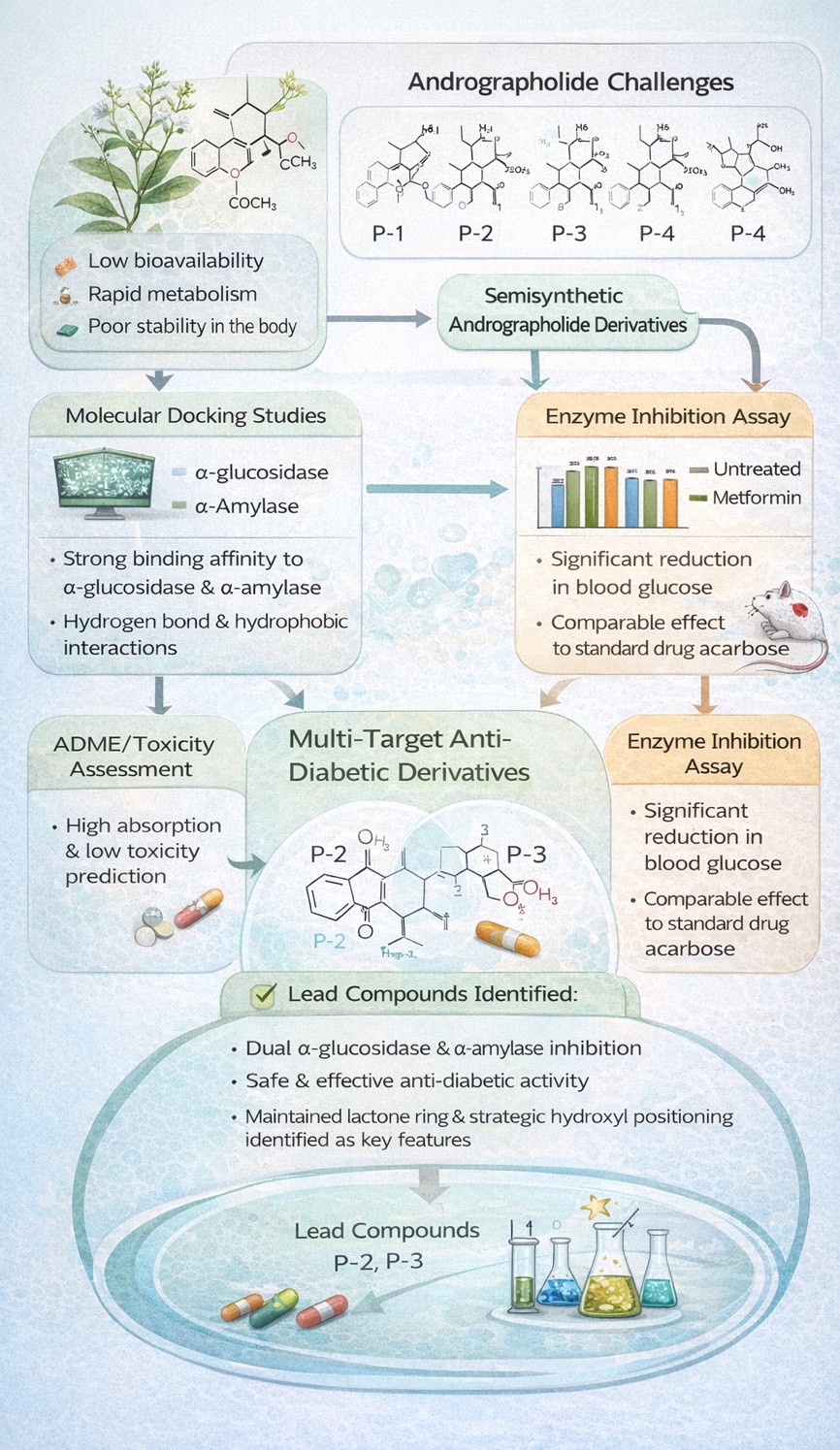
Andrographolide was diterpenoid lactone located in the plant Andrographis paniculata. It has attracted attention for its potential to help people with diabetes. However, its use is limited by low oral bioavailability, rapid metabolism, and poor stability in the body. To address these issues, this study used a rational design approach to create and test semisynthetic andrographolide derivatives that target enzymes involved in controlling blood sugar after meals. we are synthesised 4 derivatives (P-1 to P-4) and determined the three structures. Molecular docking studies with α-glucosidase and α-amylase show how are compounds bind and inhibit the enzymes. Derivative P-2 and P-3 show stronger binding affenity make the stable hydrogen bonds & hydrophobic interactions with parts of the enzyme. it means they inhibited the enzyme more effectively than the other compound. Laboratory enzyme inhibition test supported this result, showing that P-2 and P-3 have been show strong dual inhibitory effect like the standard drug acarbose.In vivo experiments utilised streptozotocin-induced diabetic rats (n=10 per group), with untreated controls. Experiments were randomised but not blinded. Statistical analysis using ANOVA confirmed significant, dose-dependent reductions in blood glucose, increased insulin secretion, and substantial decreases in HbA1c, particularly for P-2 at higher doses. Notable limitations include the small sample size and absence of long-term follow-up. Structure–activity relationship analysis indicated that maintaining the lactone ring, optimally positioning hydroxyl groups, and achieving a balanced hydrophobic–hydrophilic profile are critical for anti-diabetic efficacy. In silico ADME and toxicity assessments predicted favourable pharmacokinetic properties, high gastrointestinal absorption, minimal cytochrome P450 inhibition, and acceptable safety profiles for the most active derivatives. Overall, these results highlight the promise of structurally optimised andrographolide derivatives as multi-target anti-diabetic agents and demonstrate the value of integrating molecular docking, structure–activity relationship analysis, and biological validation in natural product-based drug discovery.